
Call (480) 741-3101 Request a callback
What an asphalt overlay is on a Mesa driveway or lot
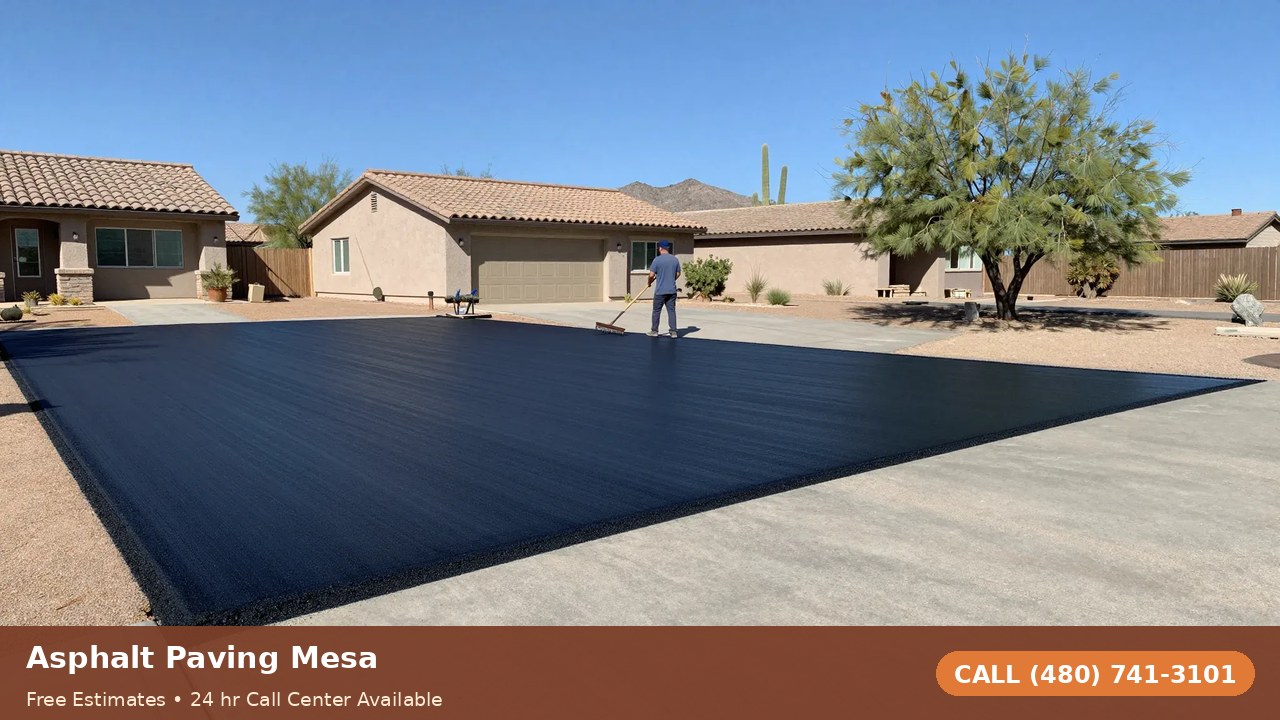
An overlay is a new mat of hot-mix asphalt, usually 1.5" to 2" thick, laid over the old surface with a tack coat and rolled while hot. It is one form of resurfacing. Done right, it adds a decade or more of life to a driveway or lot whose base is still holding. Done wrong — over a failed base, without proper edge treatment, or with too much thickness — it fails at the edges inside a couple of years.
The three conditions we check before we quote an overlay
First: the base. If the underlying pavement is sinking, alligator-cracking whole panels or ponding, the base has failed and the honest call is a tear-out, not an overlay. Second: the cracking pattern. Hairlines and single-line cracks are surface aging; chicken-wire cracks are base failure. Third: the elevation. Adding 1.5" to 2" changes the driveway height — does it still clear the garage door, does it still drain into the gutter, does the tie-in to the sidewalk still work? If all three answers pass, an overlay is on the table.
Milling the edges before the overlay
We do not lay an overlay against a garage door, a curb or a sidewalk without milling the edge first. The edge is milled down 1.5" to 2" for a few feet back, so the new mat can tie in flush instead of stepping up. Skip the mill and you get a lip at the garage door that scrapes cars, a step at the sidewalk that trips people, or a raised edge that fails at the joint. The mill is not a cost line to fight over; it is what makes the overlay work.
Tack coat — the invisible piece
Between the old surface and the new mat goes a tack coat — a thin spray of asphalt emulsion that bonds the two together. Without it the new mat sits on top like a rug and separates. We tack the whole surface, tack the vertical edges of any cuts, and give it enough time to break before the pave crew walks on it.
The mat itself — thickness, temperature, roll
Overlay thickness is typically 1.5" for a driveway that only needed a fresh top and 2" where the driveway sees heavier vehicles. The mix leaves the plant hot and has to stay in the compaction window through pour and roll. Roller passes give the mat its density; density gives the mat its life. Thin overlays under-rolled fail early.
Timing and cure — what to expect
A residential overlay is usually a one-day job: mill the edges in the morning, tack, lay the mat, roll, hand-work. Walkable in a few hours; drivable for passenger cars about a day or two later in Mesa heat; back to full duty a few days after. Business lots go the same but phased.
What a Mesa driveway job usually looks like on paper
Every driveway in Mesa is different — slope, sun exposure, base condition, and the depth of the sub-base all move the price. See the Mesa driveway cost page for a full line-item table with US market reference ranges. These are US market reference ranges for budgeting - the written quote after the walk-through is the price.