
Call (480) 741-3101 Request a callback
What sealcoating actually does for a Mesa driveway
Sealcoat is a sacrificial wearing surface pulled thin over the top of the asphalt. It does three things: it puts a fresh black look on a driveway that has gone gray with oxidation, it slows the next round of UV damage from the Mesa sun, and it fills the surface pores so gas, oil and irrigation water do not soak into the mat and break down the binder. It is not a structural repair — sealcoat over a failed base will not save it — but on a sound driveway it is one of the most cost-effective maintenance steps you can take.
Prep is where sealcoat jobs stand or fall
The single biggest difference between a sealcoat that lasts three years and one that peels off in six months is prep. We power-blow the whole surface, hand-scrape the edges where dust and gravel gather, and rout and fill any hairline cracks with hot rubberized sealant. Oil spots get a primer so the seal actually bonds; grease patches at parking spots on business lots need extra attention. If we cannot prep it properly — wet weather, gravel not off — we do not seal it.
Two passes with a squeegee and a spray
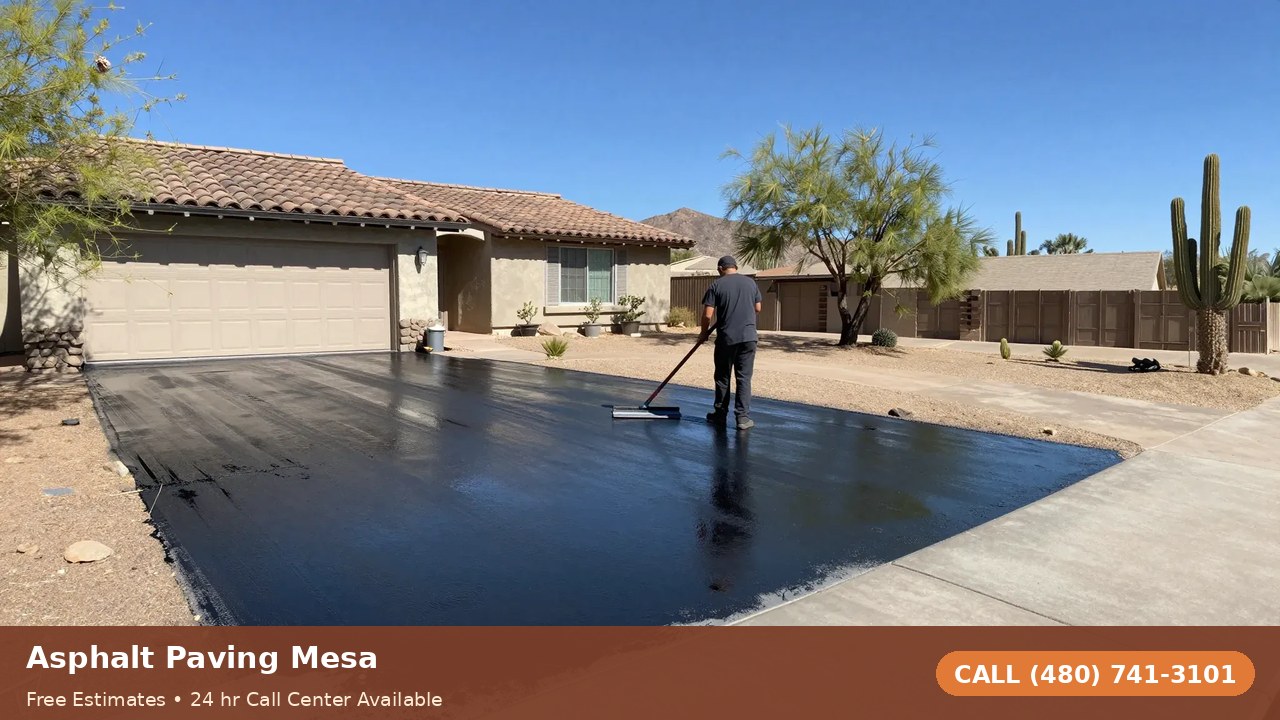
Sealcoat goes down in two coats, not one thick pull. The first coat is applied by squeegee to work it into the surface pores; the second coat is sprayed for finish. The two-coat build is what gives you the film thickness that lasts — one heavy coat looks the same on day one but wears through faster because the film sits on top instead of keying in.
Cure time in the Mesa heat — planning around it
Fresh sealcoat needs a cure window. In Mesa summer temperatures that window is short — walkable in a few hours, drivable in about a day. In cooler months it takes longer because sealant cures on temperature, not the calendar. We plan sealcoat jobs so the cure window lands on nights and weekends when the driveway is empty; on business lots we phase half at a time so parking is not lost.
When to sealcoat and how often
A new driveway usually gets its first sealcoat about a year after it is laid — long enough for the plant oils to fully cure out and the surface to open enough for the seal to bond. After that, every 2 to 4 years is normal in Mesa, depending on sun exposure and traffic. A shaded driveway holds up longer than a west-facing one under all-day sun. On business lots the interval is often shorter because of the traffic.
Sealcoat is not a fix for cracks or holes
If the driveway is cracked, sinking or has potholes, sealcoat is not the answer — those need to be repaired first. See the asphalt repair page for cracks and sink spots, and the pothole repair page for holes. When the repairs are done and cured, the sealcoat pull hides the seams and pulls the driveway back to a consistent black. On a long gravel or acreage drive that has never been paved, sealcoat has nothing to bond to — a chip seal driveway is the surface option to compare there.
What a Mesa driveway job usually looks like on paper
Every driveway in Mesa is different — slope, sun exposure, base condition, and the depth of the sub-base all move the price. See the Mesa driveway cost page for a full line-item table with US market reference ranges. These are US market reference ranges for budgeting - the written quote after the walk-through is the price.