
Call (480) 741-3101 Request a callback
What paving a driveway in Mesa actually involves
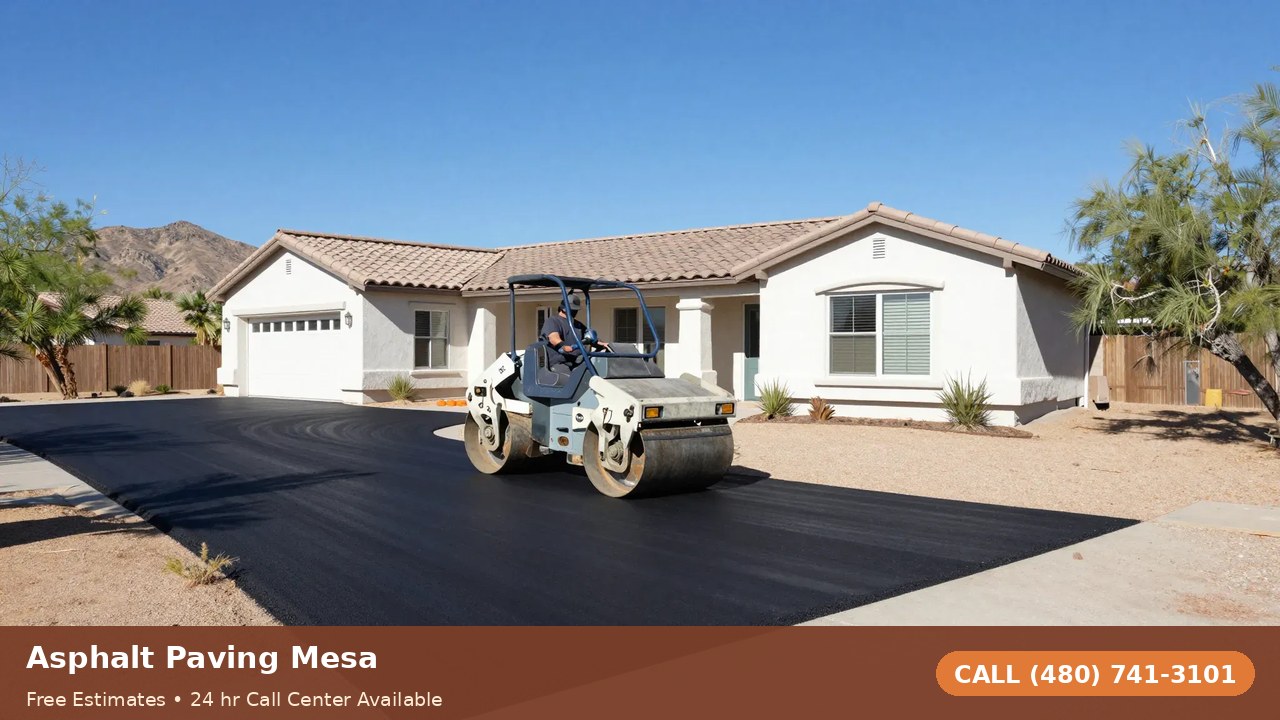
A new driveway is more than a black stripe of asphalt. The old surface has to come off, the base has to be checked and often reworked, and the new hot mix has to go down at temperature and be rolled while it is still hot enough to compact properly. Skip any of those steps and the driveway looks fine for a season and then starts to fail. On a typical Mesa home the sequence is: mill or break out the old surface, haul off the spoils, cut back the soft edges, add and grade an aggregate base to line and level, tack the tie-in edges, lay 2" to 3" of hot mix at 300°F+, and roll until the mat holds density.
Reading the driveway before we price it
On the walk-through we look at the base first. A driveway that is only cracked at the wearing surface, with no sinking or wide separation, is a candidate for an overlay or resurface. A driveway with alligator cracking across whole panels, with wheel-path depressions, or with a pond that lingers a full day after a monsoon storm, has base failure and needs a tear-out. We also check where the driveway meets the garage door threshold, where it meets the street cut and the gutter, and how it drains toward the yard or the storm inlet. All of that goes into the quote and into what the crew is told on the pre-pour tailgate.
Sub-base and base — why they matter in a desert climate
Under the black surface is a layer of compacted aggregate base and, below that, the native subgrade. In Mesa a lot of the native ground is caliche — hard, but it moves when it gets wet. The base course is what keeps the driveway from mirroring the movement. On a residential driveway we typically build 4" to 6" of aggregate base compacted in lifts. On a driveway that sees an F-250 or a boat trailer, that goes up. We tell you what we are building under the asphalt so the quote number ties back to real depth, not to a guess.
The hot-mix top — temperature, thickness, roll
Asphalt is time-sensitive. The mix leaves the plant at around 320°F and cools all the way to the site; if it drops below the compaction window before it is rolled, density is lost and the mat will ravel early. That is why we schedule pours around plant hours and truck loops, and why the crew stays on the site until the roller has done its passes. Residential driveways usually get 2" of top course over a base course; heavy-use commercial pads get 3" or a two-lift binder-and-surface layout.
Tie-ins — the edges that fail first if you skip them
The parts of a new driveway that fail first are almost always the tie-ins — where the fresh mat meets the garage slab, the sidewalk, the gutter or the street. A clean saw cut, a tack coat that actually sticks, and a rolled edge is what keeps water from working under the mat. We hand-work those joints, we tack them with emulsion, and we roll them tight. It is the difference between a driveway that reads clean at the edges after a year and one that has water tracking underneath.
Timeline for a typical Mesa driveway
A single-car straight driveway is normally a one-day job: demo in the morning, base and pour by mid-afternoon, roll and hand-work through late afternoon. A double-wide with a turnaround is often a day and a half. Big residential jobs — long ranch driveways out toward Apache Junction — can run two to three days depending on access and how much base has to be rebuilt. We tell you the day-count before we start, so you know how to park.
What a Mesa driveway job usually looks like on paper
Every driveway in Mesa is different — slope, sun exposure, base condition, and the depth of the sub-base all move the price. See the Mesa driveway cost page for a full line-item table with US market reference ranges. These are US market reference ranges for budgeting - the written quote after the walk-through is the price.